Visualizzazione post con etichetta who what where. Mostra tutti i post

Carlo Francesco Nuvolone. Who/What/Where

0
CHI/WHO: Carlo Francesco Nuvolone (1609-1662)
COSA/WHAT: The Artist and his Family / l'artista e la sua famiglia
DOVE/WHERE: Pinacoteca di Brera, Milano
Read More

John Atkinson Grimshaw. Who/What/Where

0

CHI/WHO: John Atkinson Grimshaw
COSA/WHAT: Stapleton Park near Pontefract Sun (1877), 43.5 x 28 cm
DOVE/WHERE: Private CollectionCiao a tutti.
1.000 GRAZIE a tutti voi.
1.000 THANK YOU to all of you.
Read More

Jaques Louis David, Who/What/Where

0
 
CHI/WHO: Jaques-Louis David
COSA/WHAT: "Belisario riconosciuto" / "Bélisaire demandant l’aumône", (1781) olio su tela

Read More

Sorolla y Bastida Cuando . Who/What/Where

0


CHI/WHO: Sorolla y Bastida Cuando (1863 - 1923, Valencia)
COSA/WHAT: Cucendo la vela / Cuando la vela

Who / What / Where Is a path to know an artist, his work and the place where it can be admired.
Who / What / Where E' un percorso per conoscere un'artista, una sua opera e il luogo in cui poterla ammirare.


Rosso Fiorentino. Who/What/Where

0

 
CHI/WHORosso Fiorentino (Firenze 1495-Fontainebleau 1540)
COSA/WHATAngioletto Musicante
DOVE/WHERE: Uffizi, Firenze
 
Who / What / Where Is a path to know an artist, his work and the place where it can be admired.
Who / What / Where E' un percorso per conoscere un'artista, una sua opera e il luogo in cui poterla ammirare.


Sir Lawrence Alma Tadema. Who/What/Where

0

CHI/WHOSir Lawrence Alma-Tadema
COSA/WHATA Favorite Custom, 1909, oil on panel
DOVE/WHERE: Tate Gallery, London.
An extraordinary artist, a wonderful picture, stored in a magical place.
You have to see him live!
Un artista straordinario, un quadro meraviglioso, conservato in un luogo magico.
Dovete vederlo dal vivo!
See more: TATE

Orazio Riminaldi. Who/What/Where

0

CHI/WHOOrazio Riminaldi
COSA/WHATDaedalus and Icarus, c.1625 
DOVE/WHERE: Wadsworth Atheneum Museum of Art, Hartford, Connecticut
I love the myth of Daedalus and Icarus, because it expresses the desire to decide their own fate and risk everything for their freedom. If I find a work that represents this mythological story the public, as I have done for the post of Frederic Leighton.
The work I present here shooting a highlight of the preparation of Icarus and evidences the extraordinary tension before undertaking his flight.
Amo il mito di Dedalo e Icaro, perchè esprime il desiderio di decidere il proprio destino e di rischiare tutto per la propria libertà. Quindi appena trovo un'opera che rappresenta al meglio questa storia mitologica ve la mostro, come ho già fatto per il post su Frederic Leighton.
L'opera che presento qui rappresenta un momento saliente della preparazione di Icaro ed esprime in modo straordinario la tensione prima dell'impresa del suo volo.

Gericault. Who/What/Where

0
 
CHI/WHO: Theodore Gericault
COSA/WHAT: La zattera della medusa (1819). Olio su tela 491 x 716 cm 
DOVE/WHERE: Louvre, Parigi.
Today I dedicate a post to a marvelous work and intense. A few words about the author and the rest some information on where to see it. Jean-Louis André Théodore Géricault (26 September 1791 – 26 January 1824) was a profoundly influential French artist, painter and lithographer, known for The Raft of the Medusa and other paintings. Although he died only 33 years old, he became one of the pioneers of the Romantic movement. To learn more visit the website of the Louvre Museum where there is a full record of the work: click here.
 
Oggi dedico un post ad un'opera meravigliosa e intensa. Poche parole sull'autore e per il resto alcune informazioni su dove vederla. Jean-Louis André Théodore Géricault (26 Settembre 1791 - 26 Gennaio 1824) è stato un artista, pittore e litografo francese molto importante, conosciuto per la Zattera della Medusa e altri dipinti. Sebbene sia morto a soli 33 anni, è diventato uno dei pionieri del movimento romantico. Per saperne di più visita il sito del Museo del Louvre dove si trova una scheda completa dell'opera: clicca qui.

Tiziano. Who/What/Where

0
CHI/WHO: Tiziano
COSA/WHATLa Pietà - 1576
DOVE/WHERE: Gallerie dell'Accaddemia, Venezia

Tiziano Vecellio,known as Tiziano (1473-1490c.a. – 1576), was born in Pieve di Cadore, near Belluno in the Republic of Venice. He is the most important member of the 16th-century Venetian school.
The painting is titled La Pieta monster. It is, according to tradition, the last work of Titian, because it was found in the study of the master unfinished at his death on 27 agorsto of 1576 due to an epidemic of plague. The work was finished by Palma the Younger as the inscription on the lower canvas: "QUOD Titianus INCHOATUM RELIQUIT / PALM REVENTER ABSOLVIT / DEOQ. DICAVIT OPUS ".
The Pieta was built by Titian for his own tomb in the Church of the Frari, and is an ex-voto, imploring an end of the plague. In the lower right is a votive tablet, with Titian and his son Orazio intent to seek divine intercession to be saved by the epidemic, theme taken from the arm that appears at the foot of the Sibyl, pleading, which expresses the anguish of the artist for the disease. All this will not be enough, and both father and son will be killed by the epidemic.
This work, in addition to being the last work of Titian, is part of the group of paintings that you have a more intense and extreme, where instead of a brush the color is faded and stretched out with your fingers. These are works that seem to be ahead of times and have a style that is in some ways closer to what you will see in the following centuries with the Impressionists and reminiscent of the style "unfinished" by Michelangelo.


Tiziano Vecellio, conosciuto semplicemente come Tiziano (1473-1490c.a. – 1576), nacque a Pieve di Cadore, vicino a Belluno e facente parte della repubblica di Venezia. Egli è il pittore più importante della scuola veneziana del 16° secolo.
Il dipinto che qui vi presento è intitolato La Pietà. Si tratta, secondo la tradizione, dell’ultimo lavoro del Tiziano, poichè fu trovato incompiuto nello studio del maestro alla sua morte il 27 agorsto del 1576 a causa dell’epidemia di peste che infuriava a Venezia quell’anno. L’opera venne ultimata da Palma il Giovane come attesta l’iscrizione posta in basso sulla tela: “QUOD TITIANUS INCHOATUM RELIQUIT/ PALMA REVENTER ABSOLVIT/ DEOQ. DICAVIT OPUS”.
La Pietà venne realizzata dal Tiziano per la propria sepoltura nella Chiesa dei Frari ed è un ex voto, per implorare la fine della peste. In basso a destra appare una tavoletta votiva, con Tiziano ed il figlio Orazio intenti a chiedere l'intercessione divina per essere salvati dall'epidemia, tema ripreso dal braccio che compare ai piedi della Sibilla, implorante, che esprime l'angoscia dell'artista per la malattia. Tutto ciò non basterà ed entrambi, padre e figlio, saranno uccisi dall'epidemia.
Quest’opera, oltre ad essere l’ultimo lavoro del Tiziano, fa parte del gruppo di dipinti che si hanno uno stile più intenso ed estremo, dove al posto del pennello il colore è steso e sfumato direttamente con le dita. Si tratta di opere che sembrano precorrere i tempi e hanno uno stile che per certi versi si avvicina a ciò che si vedrà nei secoli successivi con gli impressionisti e che ricordano lo stile “non finito” di Michelangelo.


Tarquinio e Lucrezia dell’Akademie der Bildenden Künste di Vienna


Incoronazione di spine dell’Alte Pinakothek di Monaco


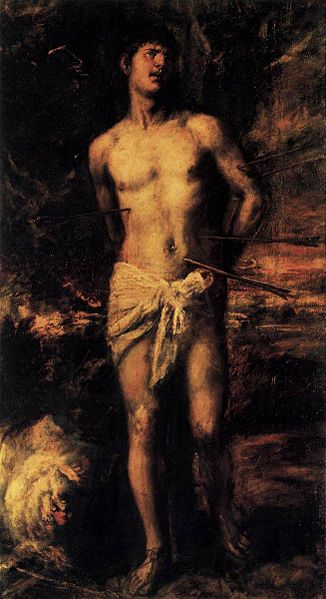
San Sebastiano dell’Ermitage di San Pietroburgo


Ecce Homo nelle versioni del Prado


Andy Warhol, Who/What/Where

0

CHI/WHO: Andy Warhol
COSA/WHAT: Marilyn Monroe (Marilyn) - 1967
DOVE/WHERE: The Museum of Modern Art, MoMa, New York
For Marilyn, Warhol created ten highly variable portraits, exploiting the possibilities in screenprinting for shifting colors and off-register effects. By celebrating the seemingly impervious veneer of glamour and fame of Marilyn , but acknowledging its darker inner complexity, these prints reveal Warhol's subtle grasp of American culture.
 
Per Marilyn, Warhol ha creato dieci ritratti diversificati, sfruttando le possibilità della serigrafia nel modificare  colori ed effetti. Celebrando il fascino apparentemente impenetrabile del glamour e della  fama di Marilyn, ma riconoscendo la sua personalità complessa e oscura, queste stampe rivelano l'acume di Warhol nell'afferrare l'essenza della cultura americana.
 
More info
MoMa, website

Velázquez. Who/What/Where

0

CHI/WHO: Velázquez
COSA/WHAT: L'Infanta, or Famiglia di Felipe IV / Las Meninas, or The Family of Felipe IV (a. 1656)
DOVE/WHERE: Museo National del Prado, Madrid

A portrait of the Infanta Margarita, daughter of Felipe IV (1605-1665), surrounded by her servants and family in a hall of Madrid’s Alcázar Palace. This, the most famous of Velázquez’s works, offers a complex composition built with admirable skill in the use of perspective, the depiction of light, and the representation of atmosphere.
Un ritratto dell’Infanta Margherita, figlia di Filippo IV (1605 – 1665), circondata dai suoi servitori e famigliari in una sala del palazzo Alcàzar di Madrid. Quasta è la più famosa delle opere di Velàzquez e offre una composizione complessa e costruita con ammirevole abilità nell’uso della prospettiva, nella rappresentazione della luce e dell’atmosfera.


Museo National del Prado

Website


Johannes Vermeer. Who/What/Where

0


CHI/WHO: Johannes Vermeer

COSA/WHAT: "Lezione di Musica" / 'The Music Lesson' (c.1662-5)
DOVE/WHERE: The Royal Collection, London 

The Music Lesson (or Gentleman and Lady at the Virginal) is an oil painting on canvas 74 x 64.5 cm built around 1662 by the Dutch painter Jan Vermeer. The work is preserved at the Royal Collections at Buckingham Palace (London). In a room lit with daylight, a woman from the back, towards the back wall, playing the spinet, while a man, standing, listens.
 
La lezione di musica (o Gentiluomo e dama alla spinetta) è un dipinto ad olio su tela di cm 74 x 64,5 realizzato attorno al 1662 dal pittore olandese Jan Vermeer. L'opera è conservata presso le collezioni reali a Buckingham Palace (Londra). In una stanza illuminata a pieno giorno, una donna di spalle, verso la parete di fondo, suona la spinetta, mentre un uomo, in piedi, l'ascolta.


Ottaviano Augusto. Who/ What/ Where

0

CHI/WHO: sconosciuto/ unknown
COSA/WHAT: "Augusto di Prima Porta" o "Augusto loricato" / "Augustus of Prima Porta" or "Augustus loricato"
DOVE/WHERE: Musei Vaticani, Roma / Vaticans Museums, Rome
Statue of Augustus called "Augustus of Prima Porta" or "Augustus loricato", preserved in the Vatican Museums. It 'a Roman statue depicting the Emperor Augustus. 2.04 meters high, is made of marble. Was found in the villa of Livia, the house of Livia Drusilla, wife of Augustus, at Prima Porta. The statue of the emperor is depicted standing, with his right arm raised and gesture to draw attention: it is the pose with which it sought to silence before dell'adlocutio (inciting the army before the battle).
Gaius Julius Caesar Octavian Augustus, or better known as Octavian Augustus was the first Roman emperor. Born in 63 BC, Julius Caesar's adopted son, reigned from 16 January 27 BC to 19 August 14.


Statua di Augusto detta "Augusto di Prima Porta" o "Augusto loricato" , custodita ai Musei Vaticani.
E' una statua romana che ritrae l'imperatore Augusto. Alta 2,04 metri, è realizzata in marmo. Venne ritrovata nella villa di Livia, l'abitazione di Livia Drusilla, moglie di Augusto, a Prima Porta. La statua dell'imperatore è raffigurata in piedi, con il braccio destro alzato e il gesto di attirare l'attenzione: si tratta della posa con cui si richiedeva il silenzio prima dell'adlocutio (incitamento all'esercito prima della battaglia).
Gaio Giulio Cesare Ottaviano Augusto meglio conosciuto come Ottaviano o Augusto, fu il primo imperatore romano. Nato nel 63 a.C., figlio adottivo di Gaio Giulio Cesare, regnò dal 16 gennaio 27 a.C. al 19 agosto 14.


Musei Vaticani / Vaticans Museums
Website
Related Posts Plugin for WordPress, Blogger...